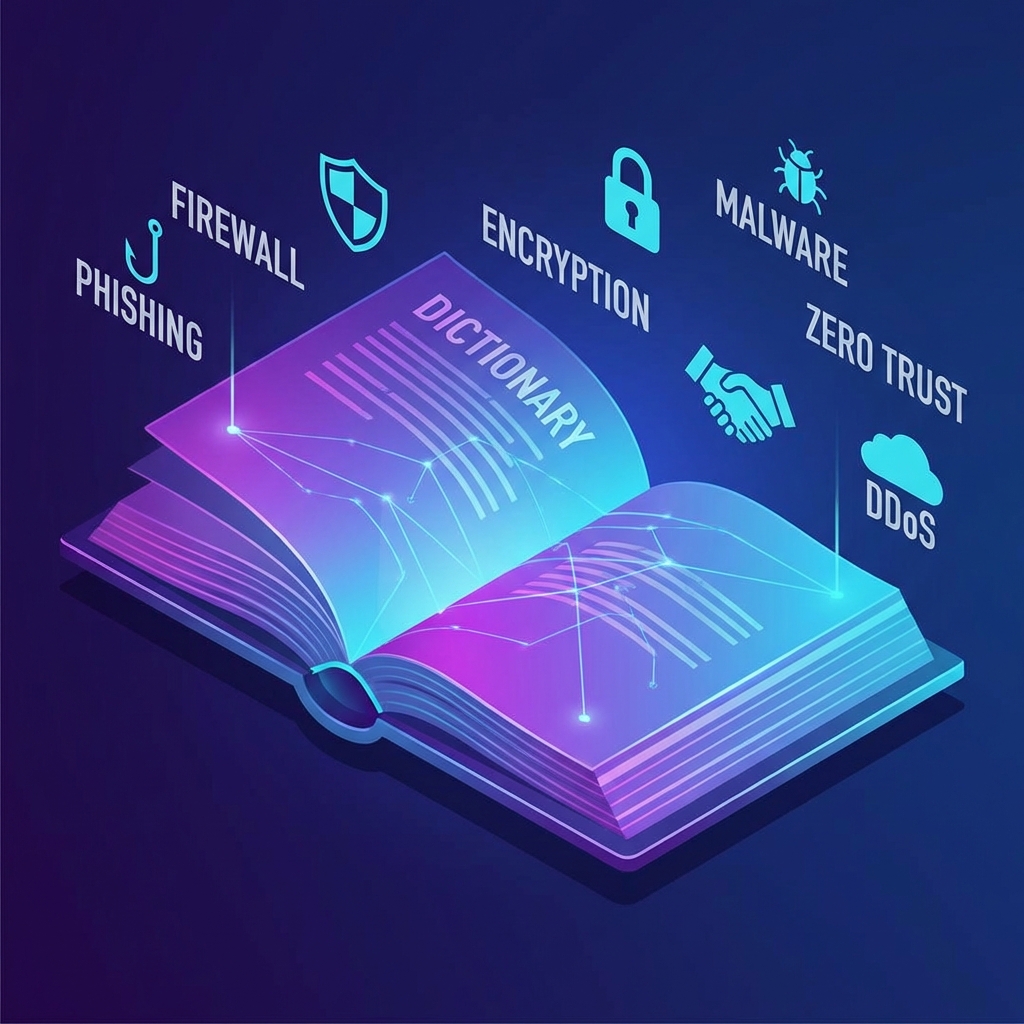
Two-Factor Authentication (2FA)
A security process requiring two different forms of identification to access an account. Typically combines something you know (password) with something you have (phone) or something you are (fingerprint).
Example: After entering your password, you receive a code on your phone that you must also enter to log in.
Encryption
The process of converting information into a code to prevent unauthorized access. Only those with the correct key can decrypt and read the information.
Example: HTTPS encryption protects your credit card details when shopping online.
Firewall
A network security system that monitors and controls incoming and outgoing network traffic based on predetermined security rules. Acts as a barrier between trusted and untrusted networks.
Example: Windows Defender Firewall blocks suspicious connections to your computer.
VPN (Virtual Private Network)
A service that creates a secure, encrypted connection over a less secure network, such as the internet. Masks your IP address and encrypts your data.
Example: Using a VPN on public Wi-Fi protects your browsing from eavesdroppers.
Patch
A software update designed to fix security vulnerabilities, bugs, or improve functionality. Critical for maintaining system security.
Example: Microsoft releases monthly patches on "Patch Tuesday" to fix Windows vulnerabilities.
Phishing
A cyber attack method where attackers impersonate legitimate organizations to trick individuals into revealing sensitive information like passwords or credit card numbers.
Example: An email that appears to be from your bank asking you to "verify your account" by clicking a link.
Ransomware
Malicious software that encrypts a victim's files and demands payment (ransom) to restore access. Can cripple businesses and individuals.
Example: WannaCry ransomware attack in 2017 affected over 200,000 computers worldwide.
Malware
Short for "malicious software." Any software intentionally designed to cause damage to a computer, server, client, or computer network.
Example: Viruses, worms, trojans, spyware, and ransomware are all types of malware.
Social Engineering
Manipulation techniques that exploit human psychology to trick people into divulging confidential information or performing actions that compromise security.
Example: A scammer calling and pretending to be IT support asking for your password.
Spyware
Software that secretly monitors and collects user information without their knowledge. Can track browsing habits, keystrokes, and personal data.
Example: Keyloggers that record everything you type to steal passwords and credit card numbers.
Man-in-the-Middle Attack (MITM)
An attack where the attacker secretly intercepts and possibly alters communication between two parties who believe they are directly communicating with each other.
Example: Intercepting unencrypted Wi-Fi traffic at a coffee shop to steal login credentials.
DDoS Attack (Distributed Denial of Service)
An attack that floods a server or network with overwhelming traffic from multiple sources, making it unavailable to legitimate users.
Example: Botnets sending millions of requests to a website, causing it to crash.
Deepfake
AI-generated synthetic media that uses deep learning to create highly realistic fake videos, images, or audio that convincingly replace or manipulate someone's likeness, voice, or actions. The term combines "deep learning " and "fake. "
Example: A fake video showing a CEO making statements they never made, or AI-generated audio impersonating someone's voice in a phone scam.
AI-Generated Misinformation
False or misleading information created or amplified using artificial intelligence technologies. Includes AI-written fake news articles, bot-generated social media posts, and automated disinformation campaigns that spread at scale.
Example: Thousands of AI-generated fake reviews for a product, or bot networks spreading false political information during elections.
Synthetic Media
Content that has been generated or significantly altered using artificial intelligence and machine learning. Includes AI-generated faces, voices, text, images, and videos that may not correspond to real people or events.
Example: AI-generated profile pictures for fake social media accounts, or completely fabricated "news footage " of events that never happened.
Voice Cloning
An AI technology that can replicate someone's voice from audio samples, creating synthetic speech that sounds like the target person. Can be used for fraud, impersonation, and unauthorized content creation.
Example: Scammers using AI voice cloning to impersonate a company executive and authorize fraudulent financial transactions over the phone.
Antivirus Software
Programs designed to detect, prevent, and remove malicious software from computers and networks. Uses signatures and behavioral analysis to identify threats.
Example: Windows Defender, Norton, McAfee, Malwarebytes.
Password Manager
Software that stores and manages passwords in an encrypted database. Generates strong, unique passwords and automatically fills them in when needed.
Example: Bitwarden, 1Password, LastPass, Dashlane.
End-to-End Encryption (E2EE)
A communication system where only the communicating users can read the messages. Prevents third parties, including service providers, from accessing the data.
Example: WhatsApp and Signal use E2EE to protect message content.
Multi-Factor Authentication (MFA)
Similar to 2FA but may require more than two forms of verification. Can include passwords, biometrics, security tokens, and location factors.
Example: Banking apps requiring password + fingerprint + SMS code.
Backup and Recovery
The process of creating copies of data to protect against loss from hardware failure, cyber attacks, or human error. Includes procedures to restore data when needed.
Example: The 3-2-1 rule: 3 copies of data, on 2 different media, with 1 off-site.
Zero Trust Security
A security model based on the principle of "never trust, always verify. " Requires verification from everyone trying to access resources, regardless of location.
Example: Requiring authentication for each access request, even from within the corporate network.
SSL/TLS Certificate
Digital certificates that authenticate a website's identity and enable encrypted connection. Indicated by HTTPS and a padlock icon in browsers.
Example: The padlock you see next to your bank's URL means it has a valid SSL/TLS certificate.
Zero-Day Exploit
An attack that targets a previously unknown vulnerability in software before the developer has released a patch. "Zero days " to fix it.
Example: Hackers exploiting a vulnerability in software before the vendor knows it exists.